
A Business Owner’s Guide to Heavy Equipment Transport in Pooler, GA for Warehouse Moves
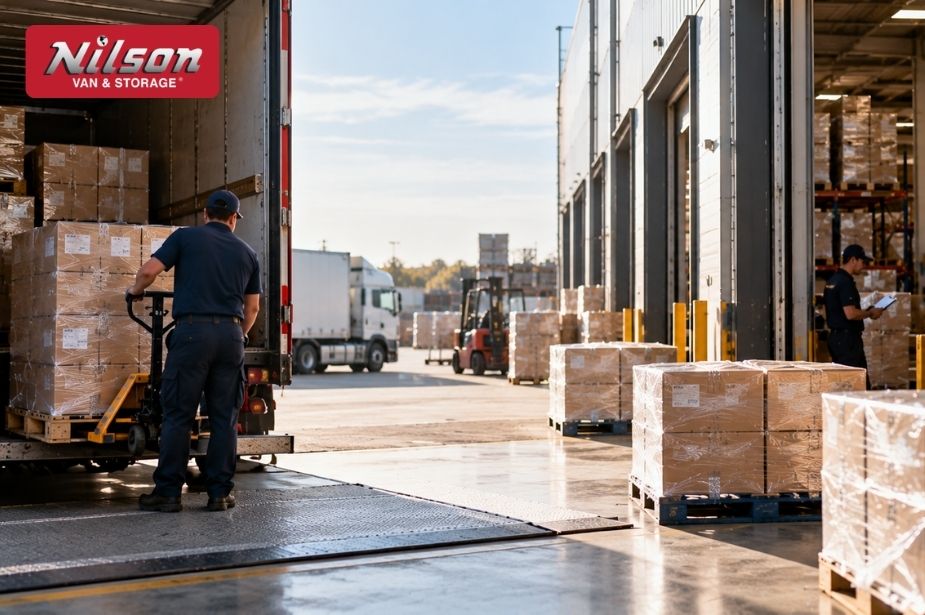
Heavy Equipment Transport in Pooler, GA can determine whether a warehouse move stays coordinated or turns into an expensive interruption. Moving forklifts, pallet racks, conveyors, production equipment, and other oversized assets requires more than putting items on a truck; it requires a workable sequence for disconnecting, preparing, loading, transporting, and placing each piece.
For a business owner, the goal is to maintain operational continuity while limiting downtime, access problems, handling surprises, and damage exposure. This guide explains how to plan warehouse equipment transport Pooler projects, what information industrial machinery movers need, how forklift transport differs from ordinary commercial moving, and when to involve Nilson Van and Storage in the process.
What Heavy Equipment Transport in Pooler, GA Involves
A warehouse relocation rarely consists of one type of item. It may include powered equipment, large workstations, shelving, inventory, office contents, tools, spare parts, and machinery that cannot be moved with ordinary carts or standard packing methods. Heavy equipment transport in Pooler, GA is the coordinated movement of those larger or more difficult assets from the existing facility to the new one.
The work usually involves several connected decisions: identifying each item, reviewing its condition and dimensions, determining how it will leave the building, selecting handling equipment, planning transportation, and confirming where it will be placed at the destination. If any one of those decisions is left until moving day, the project can slow down quickly.
Which Warehouse Assets Require Special Planning?
Weight is only one consideration. An item may need special planning because it is tall, wide, fragile, difficult to grip, attached to utilities, difficult to access, or essential to the business’s daily workflow.
Common examples include forklifts, pallet jacks, loading equipment, industrial presses, compressors, generators, conveyors, large workbenches, storage systems, and production machinery. Even a relatively moderate piece of equipment may create complications if it must pass through a narrow door, cross a sloped surface, travel through a busy loading area, or be placed close to other operating equipment.
A useful planning list should include the item’s approximate dimensions, weight, power requirements, current location, destination location, condition, and preferred move sequence. Photographs taken from several angles can help identify clearance issues before a site visit or estimate.
Why Warehouse Moves Require More Than Equipment Hauling
Equipment hauling Pooler GA projects are not simply point-to-point deliveries. The equipment must be integrated into a larger relocation schedule. A forklift may need to move first because it is required to load other assets. A conveyor may need to be removed in sections. A machine may need time for disconnection, draining, cleaning, or preparation by a qualified technician before movers handle it.
The receiving warehouse matters just as much. A clear destination on a floor plan does not automatically mean the item can reach that position. Door height, dock configuration, turning space, floor transitions, overhead obstructions, and the timing of other trades can all affect the plan.
The most reliable approach is to treat the move as a sequence of controlled handoffs rather than one large loading event.
You may also like: How to Prepare Your Machinery for Heavy Equipment Transport in Irmo, SC
Tell us about your move and get a personalized quote based on your requirements. 
How to Build a Warehouse Relocation Plan Before Moving Day
A warehouse relocation planning process should begin with the building and equipment information that determines the move’s real complexity. This is where business owners can prevent many of the delays that otherwise appear during loading or delivery. The earlier the information is assembled, the easier it is to compare options and establish a realistic schedule.
Create an Equipment Inventory With a Move Priority
Begin with a complete list of assets rather than only the largest machines. Divide the inventory into practical groups, such as heavy machinery, mobile equipment, pallet racking, packing or production stations, office contents, and items that will be discarded or sold.
Assign each item a priority based on its role in the business. Some equipment must arrive first because it supports receiving or order fulfillment. Other items can move later without affecting operations. A third group may need to remain in service until the final phase.
For each major asset, record:
- Approximate dimensions, weight, and center of gravity when known
- Current position, access route, destination position, and required placement orientation
- Utility connections, removable parts, operating condition, and preparation requirements
This inventory helps distinguish equipment that can be moved as-is from equipment that needs technical preparation. It also gives the moving coordinator a clearer basis for discussing labor, handling methods, transportation, and timing.
Survey Both Buildings, Not Just the Equipment
A warehouse move can be delayed by an access problem that has nothing to do with the equipment itself. Review dock heights, door dimensions, ceiling clearances, floor conditions, ramps, elevators, gates, parking areas, and turning space. Confirm whether the destination can receive the equipment when the truck arrives.
Pooler properties can vary considerably in layout and access. A newer industrial facility may have generous dock access, while an older or converted building may have tighter routes and less room for staging. If the move involves a business park, confirm whether property management requires advance notice, loading reservations, elevator scheduling, or proof of specific documentation.
When the route is uncertain, photographs, measurements, a walk-through, or a video call can help identify questions before the crew is scheduled. Measurements should account for the equipment’s full moving profile, including pallets, skids, protective materials, forks, and any temporary supports.
Plan Around Operations and People
The best moving date is not always the date with the least visible activity. A shutdown may be convenient for the warehouse but create a backlog for customers. Moving during active receiving hours may preserve production but restrict access and increase coordination demands.
Set a decision point for what must be operating at the old site, what can be staged, and what must be ready at the new site. Assign one decision-maker from the business who can approve changes, answer access questions, and coordinate with building representatives.
For larger projects, divide the move into phases. For example, the first phase may involve nonessential storage systems, the second may cover equipment that can be taken offline, and the final phase may move the assets needed for the last operating day. A phased approach often reduces the pressure of trying to move every item at once.
Confirm Responsibilities Before the Estimate
Clarify who will disconnect utilities, drain equipment, remove anchors, disassemble machinery, provide technical instructions, and reconnect assets. Moving professionals can coordinate handling and transportation, but specialized disconnection or reconnection may require the equipment manufacturer, an electrician, a millwright, a refrigeration technician, or another qualified provider.
This distinction is important. A moving estimate is easier to understand when the customer knows which work is included, which work is excluded, and which outside providers need to be scheduled separately.
For a Pooler warehouse move, Nilson Van and Storage can be a useful planning resource when the project includes commercial moving, packing, transportation, or storage timing. The right scope should be discussed before the move date rather than assumed on site.
Tell us about your move and get a personalized quote based on your requirements.
What Should You Ask Before Hiring Industrial Machinery Movers?
Choosing industrial machinery movers is less about finding the lowest line-item price and more about confirming whether the mover understands the project’s handling requirements. A quote that appears simple may not account for access, staging, equipment preparation, placement, or the coordination required between multiple locations.
Ask How the Project Will Be Scoped
A useful consultation should address the equipment list, dimensions, weight information, access routes, loading areas, destination conditions, timing, and placement expectations. Ask how the mover wants to receive photographs, floor plans, equipment manuals, or site restrictions.
If the estimate is based only on a general description such as “move warehouse equipment,” request clarification. The scope should identify whether the work includes packing, disassembly, loading, transportation, unloading, placement, and storage. It should also identify assumptions that could change the work, such as equipment being disconnected before the crew arrives or a dock being available at both buildings.
Ask About Handling and Placement, Not Just Transportation
Transportation is only one part of the move. The equipment must be handled at the origin and destination, and the final placement may be more demanding than loading. Ask whether the plan includes staging, protective materials, floor protection where appropriate, placement by room or work area, and coordination with your warehouse manager.
If an asset must be positioned to align with utilities, production lines, or racking, document that expectation in advance. Movers should not be expected to guess the final orientation or determine technical connections without instructions from the business and its qualified providers.
Ask How Changes Will Be Managed
Warehouse projects change. A loading dock may become unavailable, an item may be heavier than expected, or a supplier may delay the destination handoff. Before booking, ask whom to contact when a decision changes and how additional work will be reviewed.
Clear communication helps prevent a small change from becoming a scheduling dispute. It also allows the moving coordinator to explain whether an adjustment affects labor, equipment, timing, or transportation arrangements.
For local and intrastate moves in South Carolina, Nilson Van and Storage states that estimates are non-binding. Pooler is in Georgia, so the applicable estimate terms and project details should be confirmed directly for the specific move. Nilson Van and Storage also states that it does not charge cancellation fees. Valuation coverage is available, but it should be understood as valuation coverage rather than insurance. Ask for the applicable terms before the move.
Compare Capability, Communication, and Fit
When comparing providers, review more than equipment lists. Consider how clearly each company explains the plan, whether the proposed schedule fits your operating needs, how the company handles commercial coordination, and whether the scope matches the actual job.
A practical comparison should include:
- The assets included and excluded from the scope
- Loading, transportation, unloading, placement, packing, storage, and preparation responsibilities
- Assumptions about access, timing, equipment condition, building rules, and outside contractors
A provider that asks detailed questions early is often giving you a more useful planning process than one that produces a quick number without understanding the site.
Read Also: Heavy Equipment Transport in Dalzell, SC: How to Plan Moves Between Job Sites
How to Coordinate Forklift Transport and Large Equipment Handling
Forklift transport deserves separate attention because forklifts are heavy, mobile, and often essential to the move itself. They may be used to prepare other equipment, load materials, or support warehouse operations until late in the relocation. Moving them too early can create a handling gap; moving them too late can interfere with loading and departure.
Decide Whether the Forklift Moves Under Its Own Power
The answer depends on the equipment’s condition, location, battery or fuel status, access route, and the transportation plan. A forklift that operates normally may still require a specific loading arrangement. A non-operational unit, a unit with a mechanical issue, or a unit located in a confined area may require different handling.
Do not assume that a forklift can simply be driven onto a truck or trailer. Confirm who is responsible for preparing it, securing removable components, managing batteries or fuel, and directing its movement. If the equipment requires technical preparation, involve the appropriate qualified technician before the moving crew arrives.
Separate Move-Required Equipment From Production Equipment
Some equipment supports the relocation but is not part of the permanent move. For example, a forklift at the origin may be used to load machinery but remain behind, while another forklift at the destination may be needed to unload. Identify which machines are moving with the warehouse contents and which are being used as temporary handling resources.
This distinction affects the sequence, staffing, and destination plan. It also prevents an avoidable situation in which the equipment needed for unloading has already left the site or is unavailable when the truck arrives.
Protect the Schedule From Staging Problems
Large equipment should not be staged in a location that blocks emergency exits, active docks, fire access areas, or the route required for other items. Coordinate staging with warehouse leadership and property management. Keep the planned path open and make sure the receiving team knows the order in which equipment will arrive.
If a machine is traveling with loose components, label those parts and keep them together. Photographing connections, panels, and component locations before disassembly can help the receiving team restore the equipment correctly. Keep manuals, keys, controls, and special tools with the equipment or in a clearly identified package.
Read also: How to Choose the Right Heavy Equipment Transport in Camden, SC
Use Storage Only When It Solves a Real Timing Problem
Storage can help when the new warehouse is not ready, the lease dates do not align, construction is incomplete, or the business needs to clear the old facility before final placement. It can also create extra handling and an additional scheduling step, so it should be treated as a timing solution rather than an automatic part of every move.
Discuss the storage window, access needs, inventory identification, and release schedule before equipment is loaded. If the stored items will be needed to reopen operations, build the retrieval and delivery timing into the overall relocation plan.
Nilson Van and Storage offers moving and storage services that may be relevant when a commercial customer needs a temporary transition between facilities. Availability, scope, and storage arrangements should be confirmed for the particular equipment and project.
Have questions about your upcoming move? Our team is ready to help.
How Much Downtime Should a Pooler Warehouse Expect?
There is no dependable single downtime estimate for every warehouse move. The duration depends on the number and type of assets, preparation requirements, building access, the distance between facilities, the degree of disassembly, destination readiness, and whether the move is completed in phases.
A better approach is to plan downtime by activity instead of asking only how many days the move will take.
Break the Schedule Into Work Windows
Consider separate windows for preparation, disconnecting or disassembly, packing and labeling, loading, transportation, unloading, placement, setup, testing, and final cleanup. Some work can overlap, while other tasks must happen in sequence.
For example, office contents may be packed while a technician prepares a machine. Nonessential warehouse fixtures may move before the final operating equipment. At the destination, the receiving team may inspect and stage items while movers continue unloading. Mapping these dependencies reveals where time can be saved without rushing the project.
Build a Contingency for Access and Readiness
A warehouse may be ready on paper but not ready for equipment. Construction debris, unfinished floors, blocked dock doors, missing keys, incomplete utilities, or absent personnel can prevent placement. Confirm readiness shortly before the move and establish a fallback plan for items that cannot be placed immediately.
The origin also needs attention. If production runs late, equipment remains connected, or inventory has not been cleared from the route, the crew may be forced to wait or change the sequence. Assign someone to make real-time decisions and communicate those changes to the moving coordinator.
Protect Business Continuity During the Transition
Identify the minimum equipment needed to continue serving customers. If possible, keep that group operating until the destination can receive it. Prepare alternate workflows for receiving, shipping, customer orders, and employee access during the transition.
Communicate the schedule to employees, vendors, carriers, property managers, and customers who may be affected. A warehouse move can disrupt more than the moving team if delivery appointments, loading windows, or access instructions are not updated.
According to Market Research Future, the global moving services market is expected to grow from USD 20.71 billion in 2024 to approximately USD 30.01 billion by 2035, representing a CAGR of 3.43% during the 2025–2035 forecast period.
Read Also: What to Know About Heavy Equipment Transport in Pinewood, SC for Hard-to-Reach Job Sites
Wrapping Up
Heavy Equipment Transport in Pooler, GA is a business continuity project as much as a transportation project. The strongest plans begin with a complete equipment inventory, a review of both facilities, a realistic sequence, clear responsibilities, and a destination that is ready to receive each asset.
Pay particular attention to forklift transport, machine preparation, loading access, placement instructions, storage timing, and the difference between moving services and specialized technical work. These details help prevent avoidable delays and make quotes easier to compare.
Nilson Van and Storage can help business owners evaluate commercial moving, packing, transportation, and storage needs for a warehouse relocation. Discuss the equipment, access conditions, schedule, and applicable valuation terms before committing to a plan. With the right information in place, you can make a more confident decision about equipment hauling Pooler GA and move toward reopening with fewer surprises.


FAQs About Heavy Equipment Transport in Pooler, GA
Our Recent Articles
Stay informed and inspired with the latest tips, insights, and updates from the Nilson Van and Storage blog. From expert packing advice and moving checklists to stories about our commitment to the community, our articles are here to make your relocation journey smoother and stress-free. Explore our recent posts to discover how we’re redefining the moving experience for Columbia, Myrtle Beach, Charleston, Sumter, Savannah, and beyond.
How to Choose the Right Warehouse Facility for Your Business
Data Center Relocation Checklist: Key Steps for a Successful IT Move