Why Hotels Need a Reliable FF&E Logistics Partner for Renovation Projects
Why Hotels Need a Reliable FF&E Logistics Partner for Renovation Projects
FF&E logistics becomes a critical project function when a hotel renovation involves hundreds or thousands of furniture, fixtures, and equipment pieces arriving at different times and reaching the correct rooms, floors, and installation areas.
Without coordinated transportation, receiving, staging, and placement, even a well-designed renovation can lose time and create costly confusion.
Hotel renovations require more than moving boxes from one location to another. They involve procurement schedules, room-by-room inventories, access restrictions, installation sequencing, punch-list corrections, and coordination among owners, designers, general contractors, vendors, and hotel staff.
This guide explains what a capable logistics partner should manage, how hotel furniture installation affects the renovation schedule, and how to evaluate support before committing to a project plan.
Understanding Why FF&E Logistics Matters in Hotel Renovations
FF&E logistics covers the movement and coordination of furniture, fixtures, and equipment from suppliers or storage locations to the property, followed by receiving, staging, distribution, placement, and—in many projects—installation. In a hotel, these activities must fit around construction progress and the property’s operating requirements.
A logistics partner is not simply arranging transportation. The partner is helping convert a procurement plan into an organized physical process.
That distinction matters because a hotel may have guestroom furniture, case goods, mattresses, artwork, lighting, window treatments, televisions, appliances, and public-area furnishings arriving from different suppliers at different times.
The Difference Between Delivery and Project Logistics
Unlike FF&E logistics, a standard delivery usually has one primary question: where and when should the shipment be dropped off? A hotel renovation has several additional questions:
- Has the receiving area been cleared and prepared?
- Which items belong to each room, suite, corridor, or public space?
- Can the building accept the shipment through its loading area, freight elevator, or service entrance?
- Are construction activities complete enough for placement or installation?
- What happens when an item is damaged, missing, mislabeled, or delivered before the room is ready?
In FF&E logistics, these questions make timing and information as important as transportation itself. If furniture arrives before the property has a suitable staging plan, the shipment may occupy valuable space, interfere with trades, or require unnecessary handling.
Why Hotel Renovations Create More Complexity
Hotels managing FF&E logistics often have repetitive room layouts, but repetition does not eliminate detail. A small labeling error can affect an entire floor.
A missing hardware kit can delay multiple rooms. A fixture intended for a lobby may be mistaken for a guestroom item if the inventory does not identify its destination clearly.
Renovations also take place in buildings with existing operations. Guest access, staff circulation, housekeeping activity, event schedules, loading dock rules, and quiet-hour requirements may all affect the work plan.
Downtown properties may face additional access limitations, while coastal properties may need more careful attention to delivery timing and moisture-sensitive packaging during certain weather conditions.
The most effective approach is to identify these constraints before shipments begin rather than reacting to them at the loading dock. A qualified FF&E logistics partner should ask about the property, the renovation phases, the inventory, the building rules, and the desired installation sequence early in the process.
What a Strong Logistics Plan Should Clarify
Before FF&E logistics work starts, the plan should make clear who is responsible for receiving, inspection, inventory control, staging, room distribution, installation, debris handling, damage documentation, and final sign-off.
Responsibilities may be shared among the moving company, installation crew, general contractor, hotel team, and suppliers, so assumptions can create gaps.
For example, a vendor may be responsible for manufacturing a nightstand but not for bringing it from the loading area to the correct room. A general contractor may coordinate construction access but not maintain the hotel FF&E list. Clarifying those boundaries prevents tasks from being overlooked.
A practical plan also defines how changes will be communicated. Renovation schedules move. Rooms may not be released on the expected date, deliveries may be rescheduled, and replacement pieces may arrive later. The logistics process should accommodate those changes without losing track of the original inventory.
For hotel owners and project managers, the main takeaway is simple: FF&E logistics should be planned as part of the renovation—not added after procurement is complete. Early coordination gives the project team a better chance of matching deliveries, labor, access, and installation with the actual condition of the property.

Building a Workable Hotel FF&E Logistics Plan
A reliable FF&E logistics plan starts with the hotel FF&E list and then translates that information into a sequence of physical tasks. The list should be more than a purchasing record.
It should help the logistics team understand what is arriving, where it belongs, how it should be handled, and when the destination will be ready.
Start With a Detailed Hotel FF&E List
The hotel FF&E list should identify each item or item group by description, quantity, dimensions when available, destination, supplier, expected arrival, and installation status.
For room-based projects, room numbers or room types are especially useful. Public-area pieces should be tied to specific spaces such as the lobby, restaurant, conference area, fitness room, or administrative office.
An FF&E logistics inventory may also identify items that require special attention, including oversized furniture, glass components, artwork, assembled case goods, lighting, electronics, or pieces that arrive in multiple cartons. The more clearly the inventory describes the physical work, the easier it is to estimate labor and staging requirements.
The list should remain active throughout the renovation. When quantities change, replacement items are ordered, or rooms are resequenced, the revised information should reach everyone working from it. Using an outdated list is one of the easiest ways to create placement errors.
Match Logistics to the Construction Sequence
FF&E usually follows construction, but not every part of a property becomes ready at the same time. A phased plan may release several floors first, then public spaces, then remaining rooms. In other cases, the hotel may want furniture distributed by room type or by wing.
The FF&E logistics schedule should reflect the actual release plan rather than an idealized delivery date. If a flooring crew still needs access to a room, placing furniture there early may cause rehandling.
If a corridor is not complete, moving large pieces through it may create unnecessary congestion. The best sequence reduces double handling and keeps materials out of areas that are not ready.
A project manager should ask for a realistic answer to three questions: Which areas are ready? Which areas will be ready next? Which items must be held until a later phase? These answers help determine whether direct-to-room placement, temporary staging, or a combination of both makes sense.
Plan Receiving and Staging Before the First Truck Arrives
Receiving in FF&E logistics is often the point where a renovation plan is tested. The property needs enough space, personnel, and time to accept shipments, document quantities, identify visible issues, and move items into the next stage of the process.
Staging can take place in a designated room, warehouse, floor section, or other approved area, depending on the property and project. The correct option depends on available space, access, security requirements established by the property, and how quickly items will be installed.
Staging everything in one location may simplify inventory control but increase later distribution work. Staging by floor can reduce room delivery time but requires more space and more precise labeling.
A receiving plan should also address what happens when shipments arrive early or in partial quantities. Rather than treating that as an exception, the project team should decide in advance how partial deliveries will be recorded and where they will wait.
Coordinate Access, Building Rules, and Labor Windows
Hotels frequently have loading dock reservations, freight elevator procedures, approved entrances, building contacts, and restricted work periods. These details vary by property and should be verified with the hotel or building management before scheduling labor.
For FF&E logistics in urban areas such as Charleston or Savannah, access may be influenced by street configuration, limited loading areas, or building restrictions.
A Myrtle Beach property may have to coordinate work around occupancy patterns and seasonal activity. Columbia and Sumter projects may have different access arrangements, but the same principle applies: the logistics schedule must reflect the property’s actual operating conditions.
The project team should document who has authority to approve access changes. A missed loading window can affect more than one shipment when labor and installation crews are already scheduled. Clear communication reduces the chance that a small access problem becomes a full-day disruption.
The global furniture, fixtures, and equipment (FF&E) market was valued at USD 174.4 billion in 2024 and is expected to grow from USD 193.3 billion in 2026 to USD 278.6 billion by 2033, registering a CAGR of 5.4% from 2025 to 2033.
Choose Direct Placement, Staging, or a Hybrid Approach
Direct placement sends items from the receiving point to their intended room or area when the destination is ready. It can reduce handling, but it requires accurate labeling, reliable access, and a property that can keep pace with arrivals.
In FF&E logistics, staging provides more control when rooms are released in phases or shipments are arriving from several sources. It may add handling, but it can make inventory easier to organize and give the installation team a clearer work area.
Many hotel projects benefit from a hybrid approach. Ready rooms may receive direct placement, while early arrivals or items for unfinished areas are staged. The right choice depends on the building, the renovation schedule, the size of the inventory, and the consequences of rehandling.
A written plan turns these decisions into an operating process. It should identify delivery windows, responsible contacts, labeling standards, room or area assignments, inspection expectations, and the method for documenting exceptions.
Tell us about your move and get a personalized quote based on your requirements. 
How FF&E Installation Services Keep the Project Moving
FF&E installation services connect FF&E logistics with the final condition the hotel needs before a space can be turned over. Transportation and receiving may get the pieces to the property, but installation determines whether the furniture and fixtures are placed, assembled, and organized according to the project plan.
The exact scope varies by project. Some hotels need room distribution and placement, while others need assembly, fixture installation, public-area setup, debris removal, or support with punch-list items. Those expectations should be defined before work begins because installation labor, tools, sequencing, and supervision depend on the scope.
Installation Is a Sequence, Not a Single Task
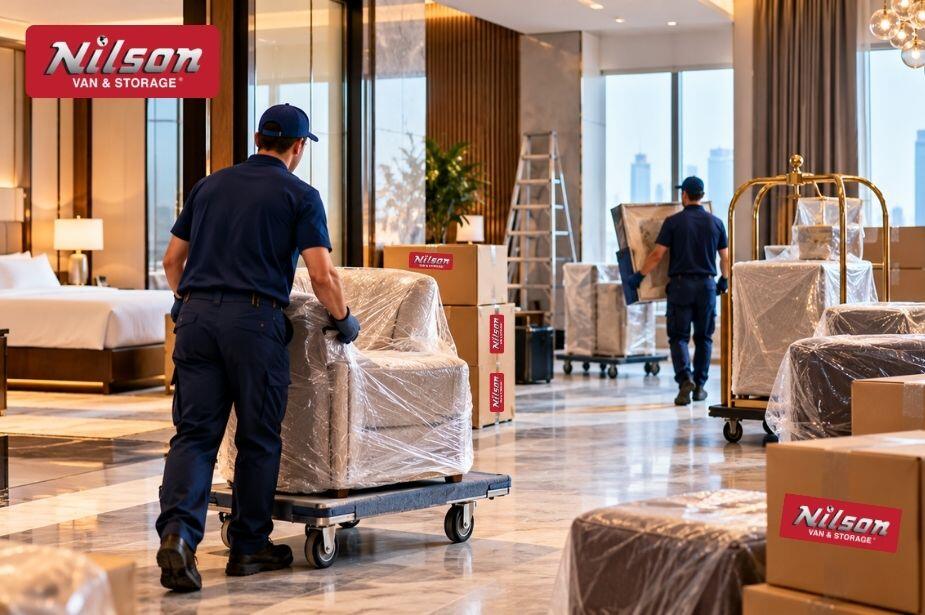
A typical hotel room may require several coordinated steps: bring in the correct pieces, place larger items first, assemble components, position furniture according to the room plan, install or set related fixtures when included in scope, remove packaging, and report missing or damaged items.
Completing one task out of sequence can make later work more difficult.
For example, placing a bed before other large case goods may restrict movement. Installing a desk before the room’s final positioning is confirmed may require rework. Leaving cartons in a corridor can interfere with other trades and make room turnover harder to evaluate.
FF&E logistics and installation planning should consider the condition of the room, the number of workers, the tools required, the floor or wall finishes, and the order in which rooms will be released.
It should also define how completed rooms will be identified so the hotel team knows which areas are ready for inspection.
Use Room-by-Room Accountability
Room-based accountability is one of the most useful controls in hotel furniture installation. Each room or area should have a clear list of expected items and a simple way to show what has been received, placed, installed, held, or reported as an exception.
FF&E logistics tracking does not have to be complicated. The project may use a digital inventory, marked floor plans, room packets, barcode records, or another method selected by the project team.
The important point is that the record reflects the physical condition of the room, not merely the supplier’s shipping status.
When the installation crew finds a discrepancy, the issue should be recorded with enough detail for the project team to act.
“Missing chair” may not be sufficient if there are several chair models. A room number, item description, quantity, and status give the procurement or construction team a usable starting point.
Manage Punch Lists and Exceptions Early
Punch-list items are normal in a renovation, but they should not disappear into informal conversations. A missing part, damaged carton, incorrect finish, or incomplete assembly should be documented and assigned to the appropriate party.
The FF&E logistics partner may not control the replacement schedule, but the team can help maintain visibility. If a replacement arrives, it should be tied back to the original room or area.
If an item is held in storage, its location should be recorded. These details prevent replacement pieces from becoming another unidentified shipment.
A disciplined exception process also helps the hotel distinguish between a logistics issue, a vendor issue, a construction issue, and a design change. That distinction supports faster decisions and clearer communication among the people responsible for resolving the problem.
Protect the Turnover Schedule Through Coordination
Hotel renovations are often judged by whether rooms and public areas are available for the next phase of work or for reopening. Installation must therefore be coordinated with inspections, housekeeping, technology work, final construction, and owner or designer review.
A reliable FF&E logistics partner communicates when work is complete, what remains open, and which rooms cannot be released. That information is more useful than a general statement that “installation is underway.” Project leaders need a current view of progress by floor, room type, or public area.
Nilson Van and Storage can support commercial moving and FF&E installation needs when a hotel requires coordinated handling, placement, and project communication. The appropriate scope should be reviewed against the property’s inventory, access conditions, renovation schedule, and installation requirements before work is scheduled.
The goal is not merely to place furniture quickly. It is to create a repeatable installation process that gives the hotel and construction team a clearer path from delivery to room turnover.
Our moving experts are here to assist you.
Choosing the Right FF&E Logistics Partner for a Hotel Project
The right FF&E logistics partner should be evaluated on process, communication, labor fit, and project understanding—not only on the ability to provide a truck or a crew.
Hotel renovation logistics can involve multiple locations, changing schedules, and detailed inventories, so a partner needs to demonstrate how those realities will be managed.
Ask How the Partner Will Handle Your Inventory
A strong provider should be able to explain how it will receive, identify, stage, distribute, and report on items. Ask whether the proposed process can accommodate partial shipments, multiple suppliers, revised room assignments, and replacement pieces.
For FF&E logistics, you should also ask what information the provider needs before preparing a plan. If the conversation never addresses the hotel FF&E list, property access, installation scope, room release schedule, or staging space, the estimate may not reflect the actual work.
Confirm the Scope of FF&E Installation Services
“Installation” can mean different things to different project teams. Confirm whether the scope includes unloading, receiving, inspection for visible condition, staging, room distribution, assembly, placement, fixture installation, packaging removal, debris handling, punch-list support, or only selected tasks.
It is also important to identify what is excluded. Some items may require specialized trade work, electrical connections, plumbing, wall attachment, technology configuration, or manufacturer-specific installation. Those requirements should be assigned to the appropriate contractor rather than assumed.
A clear FF&E logistics scope helps prevent change discussions at the loading dock and makes labor planning more realistic.
Evaluate Communication and Change Management
Renovation schedules rarely remain exactly as first drafted. Ask how the provider handles a delayed floor, an early shipment, a revised room sequence, or a missing item. The answer should include a communication process, not just a promise to be flexible.
Useful FF&E logistics questions include: Who is the project contact? How are schedule changes approved? How are exceptions documented? How often will progress be reported? Who confirms that a room or area is ready for the next step?
At Nilson Van and Storage, the planning conversation should focus on the actual project conditions rather than treating every hotel move as identical. That allows the scope, labor, timing, and handling plan to be considered together.
Review the Estimate for Clarity
An FF&E logistics estimate should make the planned work understandable. It should identify the service scope, locations involved, expected timing, assumptions, and any information still needed.
If the project is a local or intrastate move in South Carolina, remember that those moves are non-binding except for office moves, for which Nilson Van and Storage may provide a bid; final conditions and the agreed scope should be discussed clearly with the moving company.
Nilson Van and Storage offers valuation coverage for moving services. Ask questions about the applicable valuation terms, limitations, and how they relate to your project. It is also useful to understand the company’s cancellation policy; Nilson Van and Storage does not charge cancellation fees.
These details may not be the most visible part of a hotel renovation plan, but they contribute to clearer expectations. A decision based only on a low initial number can become more expensive if the scope, access requirements, or handling assumptions were never defined.
Look for Evidence of Practical Coordination
Ask the FF&E logistics provider to describe how it would approach your specific project. A useful answer should address the property type, renovation phases, inventory organization, access points, staging, labor windows, and installation sequence. General claims are less helpful than a concrete discussion of how the work would unfold.
For a hotel group renovating properties in South Carolina or Georgia, regional familiarity may also help with planning conversations. However, the property’s own rules and conditions still need to be verified. No two hotels have exactly the same loading arrangements, elevator procedures, available staging space, or operating schedule.
The best partner is the one that makes the project easier to understand before the first shipment arrives. Clear questions, clear responsibilities, and clear reporting provide a stronger foundation than a vague promise to “handle the logistics.”
Wrapping Up
Hotel renovations depend on more than design and procurement. The project also needs a practical plan for receiving, staging, distributing, installing, documenting, and turning over furniture, fixtures, and equipment.
That is why FF&E logistics should be addressed early, using a current hotel FF&E list and a schedule that reflects actual room and area readiness.
When evaluating FF&E logistics and installation services, look for a partner that can explain the work in operational terms: how shipments will be handled, how access will be coordinated, how rooms will be tracked, how exceptions will be reported, and how changes will be managed.
Those details help reduce rehandling and give owners, contractors, designers, and hotel teams a clearer view of progress.
Nilson Van and Storage can discuss commercial moving and hotel FF&E installation requirements based on the project’s inventory, location, access conditions, and schedule.
If your renovation involves hotel furniture installation, procurement coordination, or phased placement, begin with a detailed conversation about the work your property actually needs. A well-defined plan is the first step toward a more organized renovation and a more predictable turnover process.


FAQs - FF&E logistics for Hotel Renovations
Our Recent Articles
Stay informed and inspired with the latest tips, insights, and updates from the Nilson Van and Storage blog. From expert packing advice and moving checklists to stories about our commitment to the community, our articles are here to make your relocation journey smoother and stress-free. Explore our recent posts to discover how we’re redefining the moving experience for Columbia, Myrtle Beach, Charleston, Sumter, Savannah, and beyond.

Moving in the Rain in Germany: Pros, Cons & Tips
Healthcare Relocation: 7 Tips for a Smooth Relocation