How to Pick the Right Trailer for Heavy Equipment Transport in Lexington, SC
Heavy equipment transport in Lexington, SC requires more than matching a machine to the first available trailer; the wrong choice can create loading problems, clearance issues, extra handling, and avoidable delays. Whether you are moving an excavator from a Lexington County jobsite, delivering a skid steer to a new project, or relocating heavy equipment between facilities, trailer selection should begin with the equipment and the route.
The right trailer depends on dimensions, weight, loading method, ground access, and the equipment’s center of gravity. This guide explains how lowboy, flatbed, step deck, and RGN trailers differ, what information to gather before requesting a quote, and how Nilson Van and Storage can help you plan equipment hauling from Lexington with clearer expectations.
Heavy Equipment Transport in Lexington, SC Starts With The Load
Trailer selection begins with the equipment, not the truck. A trailer that works well for a compact machine may be unsuitable for a tall telehandler, a tracked excavator, or a piece of equipment that cannot be driven onto a raised deck. Before comparing trailer types, identify the load’s actual transport requirements.
Record The Equipment’s True Dimensions
Gather the length, width, height, and operating weight of the machine as it will travel. Do not rely only on a model name or an estimated specification from memory. Attachments, buckets, booms, counterweights, forks, guards, removable cabs, and other components can change the final measurements.
Height deserves particular attention. A trailer deck may sit several feet above the roadway, so the machine’s total height includes both the equipment and the distance from the ground to the trailer deck. A machine that appears to fit by itself may become difficult to route once loaded.
Width also affects planning. Some equipment can be narrowed by folding or removing components, while other machines must travel at their full working width. The more accurate your measurements, the more useful the initial equipment hauling discussion will be.
Understand Weight Distribution
The total weight is only part of the calculation. The load must also sit in a position that works with the trailer’s deck length, axle arrangement, and loading plan. A machine with a heavy rear counterweight may distribute weight differently from a long, evenly balanced piece of equipment.
Provide the equipment’s operating weight rather than its shipping weight whenever possible. Include attachments that will remain with the machine during transport. If components will travel separately, identify their approximate weights and dimensions so they can be considered in the overall plan.
Consider How The Machine Will Be Loaded
Ask whether the equipment can be driven onto the trailer, whether it requires a loading ramp, and whether it can operate under its own power. A non-running machine may require winching or specialized loading arrangements. Equipment with low ground clearance may need a gradual approach rather than a steep ramp.
The pickup location matters just as much. A paved equipment yard, an active construction site, a residential driveway, and a muddy or uneven work area create different loading conditions. A trailer that is appropriate in theory may be impractical if the site lacks enough room to line up the equipment.
At Nilson Van and Storage, our team uses these details to understand the actual move rather than treating equipment hauling as a simple point-to-point shipment. That early discussion can identify questions before the trailer is assigned.
Tell us about your move and get a personalized quote based on your requirements. 
Comparing Trailer Types for Lexington Equipment Hauling
Each trailer type solves a different transportation problem. The best choice is usually the trailer that provides enough capacity and access without creating unnecessary complexity. Cost, availability, loading method, route conditions, and the machine’s dimensions all belong in the comparison.
Flatbed Trailer Transport
Flatbed equipment hauling is often considered when the load can be driven or placed onto a level, open deck and its height and width remain within the applicable planning limits. The open sides make loading flexible and allow access from different directions when the site layout permits it.
A flatbed may be practical for compact construction equipment, agricultural machinery, attachments, generators, and other items that do not require an unusually low deck height. It can also be useful when a crane, forklift, or other lifting equipment will place the load from above.
The trade-off is deck height. Because the equipment sits on a raised platform, the combined loaded height may be greater than it would be on a lowboy or RGN trailer. That can affect route planning, overhead clearance, and whether a tall machine can travel without modification.
Step Deck Trailer
A step deck trailer has a higher front deck and a lower main deck. This design can reduce the total loaded height compared with a standard flatbed while still offering a long, open platform for many types of equipment.
A step deck may fit equipment that is too tall for a conventional flatbed but does not require the extremely low loading angle of an RGN trailer. It can be a useful middle option for certain lifts, tractors, compact construction machines, and equipment with moderate height concerns.
The lower deck does not automatically solve every clearance issue. The loaded dimensions still need to be calculated, and the equipment must fit the usable deck length and width. Loading access should be reviewed as carefully as the trailer’s height.
Lowboy Trailer Transport
Lowboy trailer transport in Lexington, SC is commonly considered for tall, heavy, or difficult-to-load equipment. The lower deck reduces the distance between the machine and the roadway, which can help with overall height and may make a large piece of equipment easier to position.
Lowboy arrangements vary, so the trailer’s deck configuration, capacity, loading method, and dimensions should be matched to the specific machine. Some equipment may still require ramps, detachable components, or separate handling for attachments.
A lowboy is not automatically the best option simply because the equipment is heavy. The actual weight, width, height, route, and loading site determine whether it is appropriate. Choosing a larger or more specialized trailer than necessary may add complexity without solving the real constraint.
RGN Trailer for Heavy Equipment
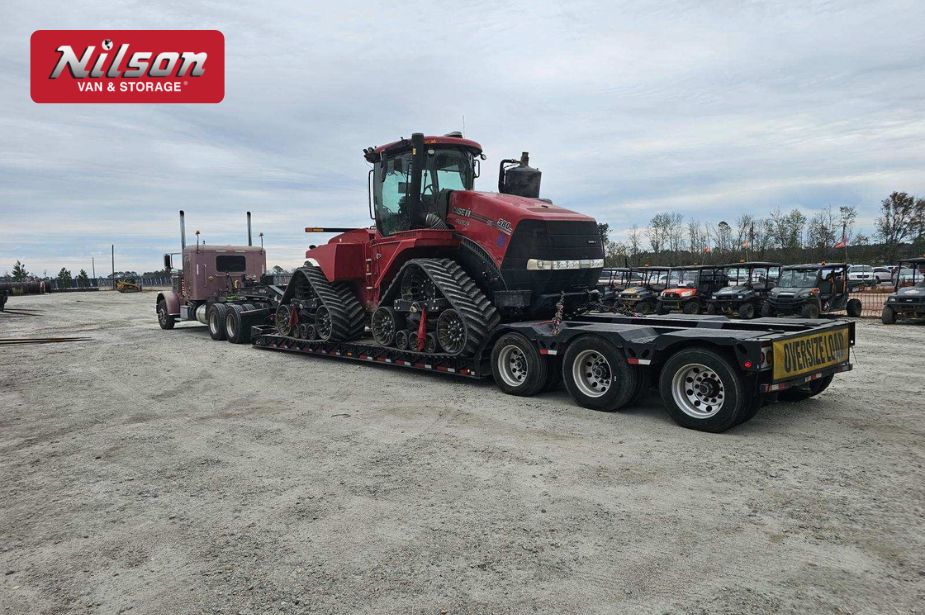
An RGN, or removable gooseneck trailer, is designed so the front portion can be detached to create a ground-level loading ramp. This arrangement can be helpful for tracked equipment, machines with limited ground clearance, and equipment that is difficult to load onto a fixed deck.
An RGN trailer for heavy equipment may be a strong candidate when the machine can be driven onto the deck but needs a gradual approach. It can also help reduce loaded height because the equipment sits lower than it would on a conventional flatbed.
RGN equipment transport can involve more planning than a basic flatbed move. The trailer must be positioned on suitable ground, enough space must be available for the loading process, and the equipment must fit the deck and capacity requirements. It is a specialized solution, not a universal answer.
A Practical Comparison
| Trailer Type | Often Considered For | Main Planning Question |
| Flatbed | Equipment that can use a raised, open deck | Will the total loaded height and loading access work? |
| Step Deck | Taller equipment needing a lower deck than a flatbed | Does the lower deck provide enough clearance without requiring a detachable trailer? |
| Lowboy | Heavy or tall machinery that benefits from a low deck | Do the machine’s weight, width, and loading needs match the configuration? |
| RGN | Equipment requiring a ground-level loading approach | Is there sufficient site space and suitable ground for detaching and loading? |
The correct answer to “which trailer do I need” comes from the complete load profile, not from weight alone.
Which Trailer Do I Need for A Specific Machine?
When customers ask which trailer they need, they are usually trying to make a decision with incomplete information. A useful way to narrow the options is to compare the machine’s height, weight, loading ability, and site conditions in that order. The goal is to identify the limiting factor first.
When Height Is The Main Constraint
Height becomes the leading concern when equipment includes a tall cab, raised boom, mast, exhaust system, or other component that cannot be lowered. A flatbed may create a greater total height than expected, while a step deck, lowboy, or RGN may provide a better starting point.
Measure the machine in its travel configuration. If a boom, bucket, or mast can be lowered or removed, confirm who will complete that work and where the component will travel. Never assume that folding one component eliminates every clearance concern.
Lexington-area routes can include a mixture of developed commercial corridors, older roads, construction access points, and jobsite entrances. The destination may be close in mileage but difficult in access, so route and delivery-site details should be discussed before final planning.
When Weight Is The Main Constraint
For heavy equipment, the trailer must accommodate the machine’s actual weight and how that weight is distributed. A machine that is within a trailer’s total capacity may still require a different arrangement if its weight is concentrated toward one end or if attachments alter the balance.
Give the moving coordinator the manufacturer’s specifications when available. Photographs of the equipment, its identification plate, and the loading area can also help clarify the situation. If the equipment has been modified, disclose those changes rather than relying on the original model specifications.
When Loading Access Is The Main Constraint
A machine that runs and can climb a ramp may be easier to load than one that must be lifted or pulled into position. Ground-level access can make an RGN attractive, while a crane-equipped facility may make a flatbed or step deck workable for equipment that cannot be driven.
The pickup and delivery sites should each be evaluated. Consider turning space, slope, overhead obstructions, surface condition, gate width, and whether other contractors or vehicles will occupy the area on the scheduled day. Building or property rules may also affect arrival timing and staging.
When A Machine Has Attachments
Attachments create two common issues: they increase the transport footprint, and they may shift the load’s center of gravity. A bucket left installed may affect width or height. A boom, arm, forks, or counterweight may need to be positioned or removed before loading.
Ask whether attachments should travel installed, separately, or with another shipment. The right decision depends on the equipment, trailer configuration, handling resources, and the final delivery plan. A separate component may require its own tie-down arrangement and may affect the quote.
A useful equipment profile includes:
- Machine make, model, year, and operating condition.
- Weight, length, width, and travel height with attachments included.
- Pickup and delivery addresses, site contacts, access restrictions, and preferred dates.
The more complete this information is, the less likely the plan will change after scheduling. Nilson Van and Storage can review these details with you when arranging heavy equipment transport for a Lexington-area project.
Planning The Pickup, Route, And Delivery In Lexington County
Trailer selection is only one part of a successful equipment move. The trailer must be able to reach the pickup point, load the machine in the available space, travel the planned route, and unload at the destination. Many preventable problems begin because the equipment is ready but the site is not.
Inspect Both Locations Before The Move
Walk or review the pickup and delivery areas before the scheduled date. Look for narrow gates, soft shoulders, steep grades, low branches, overhead utility lines, limited turning space, and equipment parked in the intended staging area.
For commercial sites, identify who controls access and whether the property requires advance notice, proof of scheduling, check-in procedures, or a designated loading window. Apartment communities, office parks, industrial facilities, and active jobsites may each have different rules.
If the equipment is leaving a construction site, coordinate with the superintendent or site contact. Confirm that the machine can be shut down, disconnected, cleaned as required by the site, and made available when the trailer arrives. Delays at the pickup location can affect the rest of the transport plan.
Account For Loading And Unloading Equipment
A trailer may arrive at the correct address but still need a ramp, winch, forklift, crane, or other resource to complete the move. Determine whether that equipment is available at the pickup or delivery site and who is responsible for operating it.
If the machine runs, check whether it can be moved by its own controls and whether the operator will be present. If it does not run, explain that before the quote is prepared. Non-running equipment can require a different loading method and additional coordination.
Coordinate With Your Project Schedule
Equipment moves are often tied to concrete deadlines: a subcontractor’s start date, a rental return, a facility shutdown, or a new jobsite opening. Build communication time into the plan rather than scheduling the transport around an assumption that every site will be ready at the exact same moment.
Weather, site activity, access restrictions, and equipment readiness can affect scheduling. Ask what information the moving company needs if the date changes and how the pickup contact should communicate updates.
For an interstate or longer-distance move, confirm the origin, destination, equipment profile, and requested timing early. For a move within South Carolina, including equipment hauling in Lexington County, local and intrastate move terms should be reviewed as part of the quote. Nilson Van and Storage states that local and intrastate moves in South Carolina are non-binding, so ask how that applies to your specific shipment and planned dates.
Review Valuation Before Scheduling
Valuation coverage is not the same as insurance. Review the available valuation terms, what they address, and whether additional coverage from another source may be appropriate for your equipment or project requirements. Do not assume that the equipment’s purchase price, replacement cost, or rental value is automatically covered in the same way.
Nilson Van and Storage can discuss valuation coverage as part of the moving conversation, but the correct details depend on the shipment and service arrangement. Ask questions before the move so expectations are clear in writing.
Our moving experts are here to assist you.
Prepare The Equipment For Transport
Remove loose tools, unsecured materials, personal items, and components that could shift during handling. Lower or secure movable parts according to the manufacturer’s instructions, and document the machine’s condition with photographs before loading.
Keep keys, operating instructions, release information, and contact details available. If the equipment has special startup, shutdown, or handling requirements, provide them before pickup rather than relying on an operator to discover them on site.
Evaluating A Heavy Equipment Transport Quote
A useful quote should help you understand the planned service, not merely show a single number. When comparing options, look at what the quote includes, which assumptions it makes, and whether the proposed trailer matches the equipment and site conditions.
Information A Quote Should Reflect
The quote discussion should be based on the equipment description, dimensions, weight, attachments, addresses, loading method, delivery conditions, and requested timing. If any of those details are unknown, identify them as open questions instead of treating an estimate as final.
Ask which trailer configuration is being considered and why. A clear explanation may reveal that the main issue is height, loading access, weight distribution, or site space. It also gives you a chance to correct an inaccurate assumption before scheduling.
Compare The Full Service, Not Just The Trailer
Two quotes may use similar language while reflecting different levels of coordination. Compare pickup and delivery handling, loading responsibilities, equipment readiness, access conditions, timing expectations, valuation coverage, and any services that are excluded or dependent on site conditions.
Do not select a trailer solely because it sounds more specialized. A lowboy or RGN may be appropriate for one machine and unnecessary for another. Conversely, choosing a basic flatbed because it appears simpler can create problems if the machine is too tall or cannot be loaded in that configuration.
Ask Questions Before Approving The Plan
Before selecting a provider, ask who will confirm the final equipment details, what happens if the machine dimensions change, whether the pickup site needs preparation, and how schedule updates should be communicated. These questions are especially important when several parties share responsibility for the equipment.
You should also understand the cancellation terms. Nilson Van and Storage’s stated policy is that there are no cancellation fees. Even with that policy, ask how a cancellation or date change should be communicated and whether site or third-party arrangements remain your responsibility.
Use A Simple Decision Framework
Start with the constraint that could stop the move: excessive height, insufficient capacity, difficult loading access, or inadequate site space. Then compare the trailer types that address that constraint. Finally, confirm the route, timing, valuation terms, and responsibilities.
For example, a running skid steer at a paved yard may be a straightforward open-deck planning question. A tall excavator at a restricted construction site is a different project, even if both are described generally as “heavy equipment.” The more specific the initial description, the more useful the equipment hauling plan becomes.
Have questions about your upcoming move? Our team is ready to help.
Wrapping Up
Choosing a trailer for heavy equipment transport in Lexington, SC is a matter of matching the equipment, loading method, route, and delivery site. Flatbeds can suit equipment that works well on a raised open deck. Step decks can help with moderate height concerns. Lowboys may fit heavy or tall machinery that benefits from a lower deck, while RGN trailers can simplify ground-level loading for certain machines.
The best choice cannot be made from weight alone. Record the machine’s complete dimensions, include attachments, explain whether it runs, review both locations, and identify any access or scheduling restrictions before requesting a quote. Those details help prevent last-minute changes and make the transportation plan easier to evaluate.
If you are arranging equipment hauling in Lexington County, Nilson Van and Storage can help you discuss the shipment details, trailer considerations, timing, and valuation coverage. Ask questions early, provide accurate information, and choose a plan that fits the actual equipment rather than an assumption about its size or weight.


FAQs - Heavy Equipment Transport in Lexington, SC
Our Recent Articles
Stay informed and inspired with the latest tips, insights, and updates from the Nilson Van and Storage blog. From expert packing advice and moving checklists to stories about our commitment to the community, our articles are here to make your relocation journey smoother and stress-free. Explore our recent posts to discover how we’re redefining the moving experience for Columbia, Myrtle Beach, Charleston, Sumter, Savannah, and beyond.
How to Choose the Right Warehouse Facility for Your Business
Data Center Relocation Checklist: Key Steps for a Successful IT Move